
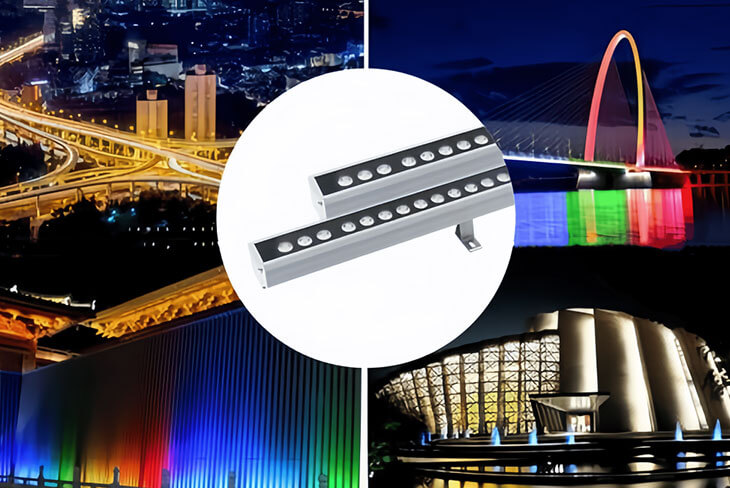
With the evolution of lighting fixtures from traditional light sources to high-power LEDs, linear lighting, and smart lighting systems, glass has become more than a simple protective cover. It has gradually evolved into a key functional component integrating optical control, structural alignment, and aesthetic presentation. Different types of lighting fixtures impose varied requirements on glass in terms of dimensions, structure, and performance, which raises higher standards for material selection and processing techniques.
Glass for spotlights typically serves as the front window, occupying a central role in both visual and optical performance. The surface quality directly impacts the overall lighting effect, and any minor defect such as scratches, bubbles, or edge imperfections can be amplified under focused light. Therefore, spotlight glass demands high surface quality and consistency.
Structurally, spotlights often use embedded or frame-mounted designs, requiring the glass to fit precisely within limited installation space. Accurate dimensions, edge processing, and step structures are critical, as improper control may cause localized stress during assembly, increasing the risk of breakage.
Optically, spotlights emphasize directional and concentrated light output. Glass transmittance and reflection control directly affect light efficiency and visual comfort. Excessive surface reflection can lead to energy loss and glare, so spotlight glass usually requires high transmittance while effectively controlling surface reflections.
Due to localized heat generation during operation, the glass must also exhibit thermal stability. Proper thickness selection and tempering improve mechanical strength and thermal shock resistance, reducing the risk of breakage from thermal stress.
Aesthetically, spotlight glass must align with the lamp body’s color, structure, and overall design. Silk-screen printing or partial masking can hide internal structures, maintaining a clean and uniform appearance even when the fixture is off. This attention to detail makes spotlight glass increasingly a functional, customized component rather than a standard part.
Wall-washer light glass is primarily used in architectural façades, landscape illumination, and linear lighting systems, often covering the entire lighting surface. Its elongated form emphasizes continuity and uniformity. Even minor deformation or dimensional deviation can be magnified in lamp arrays, affecting overall lighting quality and visual integrity.
Structurally, wall-washer fixtures typically adopt sealed designs to meet outdoor or semi-outdoor environmental requirements. Glass plays a key role in sealing performance; edge quality and flatness directly influence how well sealing gaskets adhere. Warped or uneven edges may create weak points, compromising long-term reliability.
Optically, wall-washer lights aim for uniform linear illumination. Glass not only protects the fixture but also affects light distribution. Surface flatness, internal stress, and surface treatment indirectly influence light propagation. Minor warping or uneven stress can cause brightness inconsistency or interrupted light lines, particularly in large-scale installations.
Exposed to temperature changes, sunlight, rain, and UV radiation, wall-washer glass must maintain mechanical strength and thermal stability. Proper thickness and tempering enhance impact resistance and safety, mitigating breakage risks under environmental stress.
Aesthetically, wall-washer glass must balance function and visual effect. Silk-screening or masking helps control light output, prevent side leakage, and hide internal components, ensuring a clean, consistent appearance. As linear lighting trends toward customization, wall-washer glass increasingly requires project-specific design and processing rather than standardized parts.
Glass is typically installed as a front window, secured via embedding, pressing, or frame fixation. Proper embedding depth ensures stability and distributes mechanical stress. Insufficient embedding may lead to displacement or detachment, while excessive depth can generate edge stress during assembly. For fixtures with specific protection ratings, embedding depth directly affects waterproof and dustproof performance.
Flatness is critical for lighting glass, especially elongated wall-washer panels. Slight warping during processing or tempering can be amplified after installation, affecting structural fit. For linear fixtures, poor flatness can prevent uniform gasket compression, creating weak sealing points. Flatness also influences optical performance; local surface undulations may cause uneven brightness or light streak interruptions.
In high-brightness applications, surface reflections impact light efficiency and visual comfort. Excessive reflection causes energy loss and potential glare. Anti-reflective treatments maintain high transmittance while minimizing reflections, ensuring light is directed efficiently. This is particularly important in commercial and professional lighting.
Step-edge processing is widely used to ensure stable positioning within fixtures, preventing displacement and improving assembly reliability. It distributes external pressure evenly, reducing stress concentration at edges, which is critical for long-term illumination or exposure to environmental conditions. Step edges also provide a stable base for gaskets, enhancing sealing consistency, especially for outdoor wall-washer lights. Proper step-edge design can conceal connections, maintaining a clean front appearance for high-end commercial and architectural fixtures.
Drilling is essential for structural mounting, creating screw holes, positioning holes, or installation apertures. Precision in hole size and location ensures assembly stability. Poor hole quality can lead to stress concentration, increasing the risk of breakage during tempering or thermal treatment. For waterproof or dustproof fixtures, hole placement must align with sealing components, maintaining continuous contact to prevent leakage while preserving optical and aesthetic integrity.
Tempering enhances mechanical strength and safety by introducing compressive stress layers. Under impact, tempered glass fractures into granular pieces, reducing injury risk. Spotlights and wall-washer lights experience localized heat and environmental stress; tempering improves thermal shock resistance and structural stability. For long, large panels, tempering parameters must be optimized to prevent warping, ensuring flatness and uniform light distribution post-processing.
Coating improves optical performance and visual comfort, with AG (anti-glare) coatings commonly applied. AG coatings diffuse light, reducing reflection and glare, providing soft, even illumination for spotlights, wall-washers, and linear fixtures. Coatings also enhance surface cleanliness and durability, with outdoor or high-power applications requiring resistance to UV, humidity, and temperature variations. AG coating design must balance membrane thickness and microstructure parameters to achieve glare control without compromising brightness or color rendering. In practice, AG coatings are often combined with tempering and step-edge processing to ensure strength, dimensional stability, and optimal optical and aesthetic performance.
Silk-screen printing serves decorative, optical masking, and structural concealment purposes. Printed areas can hide internal components, prevent side light leakage, and maintain a clean, uniform appearance. It also allows localized light modulation, optimizing brightness distribution and complementing optical design. High precision in pattern, color, and positioning is crucial, as it directly affects appearance and function.
As lighting fixtures evolve in functionality and design, glass has shifted from a simple protective component to a critical element integrating optical performance, structural alignment, and aesthetics. Across spotlights, wall-washer lights, and linear fixtures, glass quality and processing directly influence light output, assembly stability, and long-term reliability.
Lighting applications impose multidimensional requirements, including proper embedding, flatness control, and effective glare suppression. Processing techniques such as step-edge, drilling, tempering, AG coating, and silk-screen printing work in synergy to ensure that each component meets optical, mechanical, and aesthetic standards.
In the context of high-quality, customized, and professional lighting, glass is no longer a standard material but a functionally designed component tailored to application needs. Understanding structural and environmental requirements, combined with precise processing, ensures a balance between reliability, optical performance, and visual quality.
Ready to take your glass project to the next level? Contact us today to discuss your custom glass needs and get a quote!
contact us